I am Honored to Announce My New Author Interview With NF Reads. I Enjoy Writing.

NF READS ~ NFReads.com | Interesting Articles. Inspiring Stories.

I was honored and had the pleasure of being invited for an in-depth author interview by NFReads.com about my craft of writing, about why I wrote my book, about recovery life, and some other intriguing questions. I included and shared some book marketing tips for authors in the interview and shared about my long-term recovery as well.

I hope you will take some time to visit and read the Full Interview!

Interview with Author/Advocate, Catherine Townsend-Lyon

….
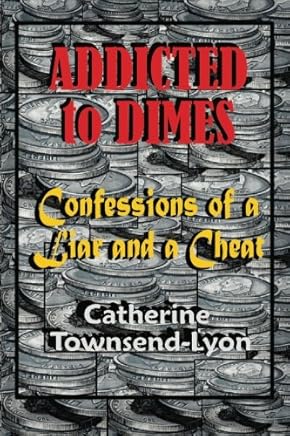
Addicted to Dimes (Confessions of a Liar and a Cheat)

“Books can come by imagination with vibrant storylines and characters. Come in many genres and about real life, or sometimes they come by way of a little “Divine Intervention” like my book.”   ~Author, Catherine Townsend-Lyon 

…..

AND The Last Question Was?

Tell us some quirky facts about yourself?

Oh my. OK. I love dill pickle slices and mayo sandwiches. I am a cat lover with three therapy cats named, Mr. Boots, Miss Prissy Princess, and Simon-Peter. I love writing when it rains and will keep my door cracked and window open to hear it while writing even if it is 20 degrees outside!

Lastly? 

Well, after everything I’ve been through in my life up to now? GOD let me keep my sense of humor!


…..

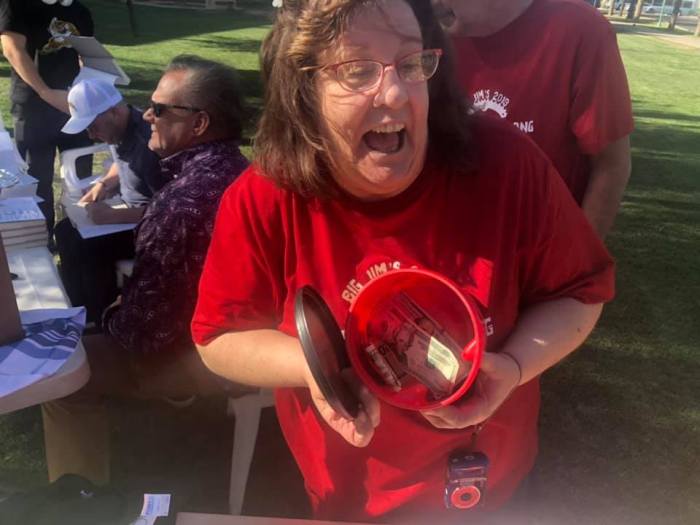
56848129_657000964754004_2110962222527152128_n(A little fun and $$$$ Raised For Big Jim’s Ride 4 Addiction at The Arizona State Capitol Event as One of The Guest Speakers – April 10th, 2019) LOL!!

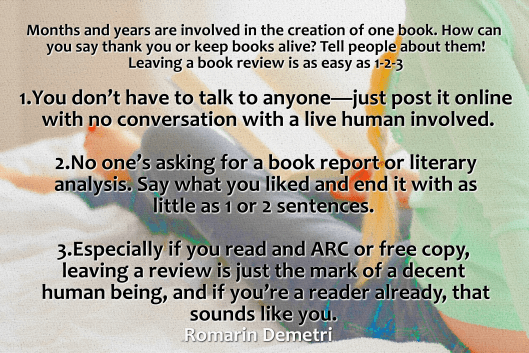
“Ode to The Book Review”… Readers? How Come You Won’t Leave a Review When Done Reading a Book?

Welcome Avid Readers. Authors, and All-New visitors, 

As a book marketer and promoting many fine authors, the biggest thing that eludes ALL AUTHORS, WRITERS, and Marketers … WHY DON’T A READER LEAVE A BOOK REVIEW? 

Seriously. I really want to know what the reason is. If you are an AVID Reader, then you know how important a book review is for a writer who hards very hard on their craft and then to have the audacity to publish their work …

AND IS WHY a book review for us is so important. Be it a good, bad, or indifferent, book reviews are a way readers can let writers know how and why they loved a read or …not so much. It offers us, as writers, maybe some corrective advice if say a good mystery was missing elements or maybe the ending could have been better.

So, I came across a few book blogs that had some good advice and shared feelings of WHY books reviews are so important and thought I’d share them. As readers, I hope it will help all my readers who visit to understand the “WHY”…  *CAT*

<<<<<<<
3367

<<<<<<,

Hello, readers!

Remember, you don’t have to purchase my books from Amazon to leave a rating or review. If you were gifted any one book, downloaded them for free, bought them, found them in a Little Library, found them at a rest area, at a mall, some other random place, etc… You can still leave a rating. I encourage and ask that you do so, regardless of how you received any copies. If you really enjoyed my books, let me know. My main concern is how well you liked my stories, not how much I can make.


Ratings and reviews really help. It helps other readers know that they are getting a good read, and it also helps me, the Author. When I see how much someone enjoyed one of my books, it reminds me why I’m doing this in the first place. I want you to have a new literary universe that you can lose yourself in after you had a long, frustrating, or busy day.

So, go ahead and leave a rating or review at AmazonGoodreadsBarnes & NobleBooks A Million, etc. You don’t have to post much more than two or three words if you don’t want to. Even just a star rating will do. After that, you can follow me on my many social media platforms.

Thanks, and I as all authors appreciate the time you spent reading our books and reading this post! 

<<<<<<<
3review1


A SAMPLE OF HOW TO WRITE A QUICK BOOK REVIEW:

Since most reviews are brief, many writers begin with a catchy quip or anecdote that succinctly delivers their argument. But you can introduce your review differently depending on the argument and audience. The Writing Center’s handout on introductions can help you find an approach that works.

In general, you should include:

  • The name of the author and the book title and the main theme.
  • Relevant details about who the author is and where he/she stands in the genre or field of inquiry. You could also link the title to the subject to show how the title explains the subject matter.
  • The context of the book and/or your review. Placing your review in a framework that makes sense to your audience alerts readers to your “take” on the book. Perhaps you want to situate a book about the Cuban revolution in the context of Cold War rivalries between the United States and the Soviet Union. Another reviewer might want to consider the book in the framework of Latin American social movements. Your choice of context informs your argument.
  • The thesis of the book. If you are reviewing fiction, this may be difficult since novels, plays, and short stories rarely have explicit arguments. But identifying the book’s particular novelty, angle, or originality allows you to show what specific contribution the piece is trying to make.
  • Your thesis about the book.


Summary of content:

This should be brief, as analysis takes priority. In the course of making your assessment, you’ll hopefully be backing up your assertions with concrete evidence from the book so some summary will be dispersed throughout other parts of the review.

The necessary amount of summary also depends on your audience. Graduate students, beware! If you are writing book reviews for colleagues—to prepare for comprehensive exams, for example—you may want to devote more attention to summarizing the book’s contents. If, on the other hand, your audience has already read the book—such as a class assignment on the same work—you may have more liberty to explore more subtle points and to emphasize your own argument. See our handout on summary for more tips.

Analysis and evaluation of the book:

Your analysis and evaluation should be organized into paragraphs that deal with single aspects of your argument. This arrangement can be challenging when your purpose is to consider the book as a whole, but it can help you differentiate elements of your criticism and pair assertions with evidence more clearly. You do not necessarily need to work chronologically through the book as you discuss it.

Given the argument you want to make, you can organize your paragraphs more usefully by themes, methods, or other elements of the book. If you find it useful to include comparisons to other books, keep them brief so that the book under review remains in the spotlight. Avoid excessive quotation and give a specific page reference in parentheses when you do a quote. Remember that you can state many of the author’s points in your own words.

Conclusion:

Sum up or restate your thesis or make the final judgment regarding the book. You should not introduce new evidence for your argument in the conclusion. You can, however, introduce new ideas that go beyond the book if they extend the logic of your own thesis.

This paragraph needs to balance the book’s strengths and weaknesses in order to unify your evaluation. Did the body of your review have three negative paragraphs and one favorable one? What do they all add up to? The Writing Center’s handout on conclusions can help you make a final assessment.

IN THE REVIEW:

Finally, a few general considerations:

  • Review the book in front of you, not the book you wish the author had written. You can and should point out shortcomings or failures, but don’t criticize the book for not being something it was never intended to be.
  • With any luck, the author of the book worked hard to find the right words to express her ideas. You should attempt to do the same. Precise language allows you to control the tone of your review.
  • Never hesitate to challenge an assumption, approach, or argument. Be sure, however, to cite specific examples to back up your assertions carefully.
  • Try to present a balanced argument about the value of the book for its audience. You’re entitled—and sometimes obligated—to voice strong agreement or disagreement.

    But keep in mind that a bad book takes as long to write as a good one, and every author deserves fair treatment. Harsh judgments are difficult to prove and can give readers the sense that you were unfair in your assessment.

  • A great place to learn about book reviews is to look at examples. The New York Times Sunday Book Review and The New York Review of Books can show you how professional writers review books.

    #########

>>>>>>>

IT REALLY IS SIMPLE!

<<<<<<<

imageedit_7_9080497309

News & Experts Are Back and Marsha Shares WHY a Media Pitch Needs To Be Well Planned To Be Successful …

4 Tips For Creating Successful
Media Pitches
 by | Feb 19, 2019

….

Anyone who’s tried their hand at promoting a brand through PR can tell you that grabbing the media’s attention isn’t always easy.

Each day, newspaper journalists, as well as hosts and producers of TV and radio talk shows, scroll through a never-ending barrage of email messages, many of which they no doubt delete without reading.

Let’s face it, they couldn’t write about or report on all those topics even if they wanted to. Time just doesn’t allow it. So, with competition for the media’s attention so fierce, is it even possible to separate yourself from the pack and land an interview that will help build your credibility as a go-to expert in your field?

I’m here to tell you that, yes, it is possible, though a challenge if you have no experience playing the media’s game, which is why so many people turn to professionals. Still, if you’re determined to do it on your own, let me share a few things you need to keep in mind that can help you achieve success.

First, remember that while your goal is to promote your personal or company brands, that’s not the media’s goal. If your pitch sounds like a commercial, the media will suggest you contact their advertising departments.

As I point out in my upcoming bookGaining the Publicity Edge: An Entrepreneur’s Guide to Growing Your Brand Through National Media Coverage, what the media actually do want is useful and interesting information they can share with their readers, viewers, and listeners.

So, with that in mind, here are four tips to help make your pitches more successful:

  • Keep it short. You no doubt have a lot to say about your topic, but don’t say it all in your pitch. Print journalists and TV and radio show hosts don’t have time to read a thesis, no matter how remarkable your insights are, so keep it succinct. Think of those pitches as more like a movie preview, not the feature presentation. Certainly, include enough information for them to get the gist of what you can talk about, but leave all those extraordinary details you are tempted to cram into the pitch for the actual interview.
    ….
  • Solve a problem. The best ideas for articles and talk show interviews are those that help solve a problem the readers or audiences face. People perk up when your message means something to them personally, such as providing them tips on how to stick with a diet or save more for retirement. Ask yourself this: What are some of the problems my clients or customers are trying to solve? Those problems—and the solutions you can offer—can be the inspiration for a pitch.
    …..
  • Playoff what’s happening in the news. You increase your chances of engaging the media’s interest if your pitch aligns with something they are already writing and talking about. What’s going on that fits into your area of expertise? Are you a surgeon who can explain a new breakthrough involving your specialty, and what it will mean to patients? Are you a divorce lawyer who can comment on the latest celebrity split? One of our clients was a scientist who could talk about an eclipse that was in the news. We kept him busy with radio interviews leading up to that astronomical event!
    ……
  • Highlight your credentials. Why should the media—and the media’s audience—listen to you? Don’t dump your entire resume in the media’s laps, but you do want to include a short summary of relevant information about your background and expertise. For example, if you are a financial professional, let them know what licenses and certifications you have, and that you’ve been a partner in your firm for 10 years.

Finally, understand that pitching the media can take patience. Your first pitch might not get any takers. Your second and third might not either.

Don’t despair. At the end of your pitches, let the media know that if they have no interest in this particular idea, you’re available to talk about other topics related to your expertise as well.

“In the publicity game, persistence pays off.”

Diligently yours!

Marsha Friedman,  PR Expert

>>>>>


My Friends At TCK Publishing Helps Authors Be Amazing Writers With These Tips and Advice . . .

Welcome Friends, Writers, and Authors,

<<<<
Today I have a featured guest article from my friend Tom Corson-Knowles, CEO of TCK Publishing who shares some amazing advice and tips on becoming a more seasoned writer. I enjoy visiting his helpful website as he shares so much it keeps me coming back often and learning more about writing, authoring, selling my books and I can pass it on book marketing tips to all my author friends and clients.

Authors, make sure you check out his upcoming 2019 “TCK Publishing Readers Choice Awards” and enter your book! There are fabulous prizes and it helps get more exposure to your book! So let’s all learn some tips on becoming Better Writers!

<<<<

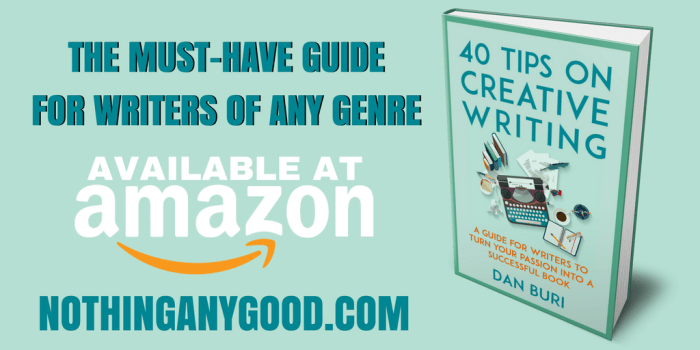
40 Tips On Creative Writing by Dan Buri FACEBOOK and TWITTER TEASER

<<<<<

“Writing professionally is a full-time job with part-time hours and never-ending responsibilities.”
Most professional writers don’t actually spend 8 hours writing each day, but that doesn’t mean they’re not working.

If you want to become a more productive writer, you have to learn to manage your work, your life, and your mental and physical wellbeing. You can’t sustain high levels of creativity and productivity as a writer without working on yourself.

Here are the 10 things that helped me become a more productive writer, and I hope these tips help you too.

1.  Schedule Your Work

You have to make time in your schedule for writing, marketing, and business time.

Don’t let a day go by without writing and working on your career. Even if it’s just 15 minutes here and there it adds up. The work habits you build will determine your success or failure.

Every day you skip your writing work, you bring yourself closer and closer to failure, anxiety, stress, and the really bad habit of procrastination that dooms far too many writers’ promising careers.

2. Study

Learn everything you can about writing, publishing, and marketing. Ignorance is not bliss. It will ruin your dreams.

Check out the best books on writing.

Learn how to improve your readability.

Understand how to do market research for writing and learn more about your customers and readers.

Every day, study so you can learn a little bit more about the incredible art of writing.

3. Make Mistakes

You’ll learn more from your mistakes than just about anything else.

Be bold. Get rejected. Publish crappy articles and books (at first).

You learn as you go and you have to be willing to fail or you’ll never learn what you need to learn to succeed.

The only difference between you and the most successful writers in the world is they’ve made more mistakes than you have. Learn from your mistakes and keep going.

4. Get Rid of Bad Habits

To become a successful writer, I had to get rid of my addiction to video games, binge-watching TV series and complaining. I also had to develop new habits like working out, taking walks, meditating, and asking for help. I had to ask hundreds of people for help along the way. I never could have done it alone.

Bad habits and addictions will destroy your creative output. You need every extra hour you can get to take care of yourself and focus on your writing career.

If you waste that time on bad habits, you’ll be shooting yourself in the foot.

5. Build Relationships

Meet other writers and creative people with big ambitions and good work habits. Just being around people who published 1, 2, or more books since you started yours will motivate the heck out of you.

You’ll see that other people are succeeding and you’ll be inspired to work extra hard to make your dreams come true.

6. Ignore the Noise

Don’t waste time with complainers, energy vampires, or depressed people. Their energy will infect you. It’s nearly impossible to create while depressed or stressed.

If you find something or someone in your life is distracting you from being productive, happy, and fulfilled, deal with it now! Putting it off will only make you feel more stressed, anxious, and depressed. And if that’s how you feel day after day after day, chances are you’ll never become a highly productive writer.

7. Manage Your Emotions

Writing is painful as hell. You will feel miserable sometimes. You’ll be scared, angry, hurt, feel emotions you haven’t felt or haven’t wanted to feel for years. It’ll open up parts of yourself you never imagined we’re there. Embrace it. Get help. See a therapist. Talk about your feelings and problems.

8. Take Care of Yourself

You are your biggest obstacle to success. You have to learn to work harder on improving yourself than you do at your writing career.

When you work on improving your life, even if it’s just a little bit, it’ll help you become more creative and productive.

Take that walk around the block. Eat healthier. Meditate. Get rid of bad relationships. Make your relationships better. Reduce your stress.

Small things may not seem that important but they can make all the difference in the world over your lifetime.  Creating is hard enough without adding 10 more problems to your life.

Solve the little problems and becoming a more productive creator will be a lot easier.

9. Add Value Always

Focus on adding value not making money.

Your readers need your help. Your job is to help them, no matter what kind of books you write. Your story and the message could change their life. It’s your job to do the best you can possibly do to help your reader. Nothing else is as important to your career as helping your readers.

When you have a big decision to make about the direction of your work, the title for your book, or any other creative decision, ask yourself:

“What’s best for my reader?”

Whatever the answer is, it’s almost always the right choice. Do what’s best for your reader. Add value to their lives. If you do that well enough, everything else will work out.

10. Experiment

If what you’ve been doing hasn’t been working, it’s up to you to change it. Do something different. Try new things. Experiment. Play like a kid. You are smart enough to figure it out if you really want to become a successful and productive writer.

Believe in yourself, believing in your dreams, and believe in your work.

You can do it if you’re willing to do the right thing day after day after day.

That’s how you build a successful life and a successful writing career.
……

…..
If you liked this post, please visit my friends from TCK Publishing as below are some other articles you might love:

HAPPY NEW YEAR YOU – Brand Yourself For 2019! Should Our Brand Be All The Same? Guest Jason From Strong Social Tells Us.

Happy New Year’s Eve and Welcome All! Brand Yourself in 2019!

>>><

imageedit_8_7596870183

<<>>>

Brand Voice – Should It Remain the Same Across All Social Networks

>><<

How is your brand personality determined?

It is largely determined by the words you use in communication, as well as the kind of sentences you write. Your brand voice reveals whether your brand is corporate, academic, deadpan, grave, serious, witty, funny, clever, and so on.

When defining a company’s brand voice, the problem is that rigid guidelines can stifle you. Your brand’s personality has to appeal to different people in different locations, so like a human personality, it has to retain some elasticity. Like, a central character that can convey a message in different tones. For example, your blog posts may appear enthusiastic and professional, while the promotional copy for your social media shares should probably be less enthusiastic.

Here’s what you should know about ways of using your brand voice across different social networks.

1. Instagram

Instagram is the place for B2B and B2C companies. On this platform, you can drive brand engagement and awareness with positive visuals and copy. Thus, on Instagram, you can use the classic marketing tone.

On Instagram, the line that divides branded content and UGC (user-generated content) is quite blurry. Also, it is more challenging to spot Ads, especially from influencers with undisclosed relationships with brands. When it comes to hashtags, Instagram is quite friendly towards the use of hashtags. According to SproutSocial, about 80% of all users follow at least one brand, while 7 out of 10 hashtags on Instagram are branded. It means that you should be as clear as possible about what you want your followers to do – click the link in Bio, tag a friend, or swipe up for a free trial if you are running ads.

<<<<

>>>>

2. Facebook

Facebook is an exciting opportunity for any brand being that it’s the most extensive social media network in the world. With 2.27 billion monthly active users, it’s very challenging to stand out and maximize your reach. You need a distinct brand voice and identity.

What makes an effective Facebook copy? It should be accessible, familiar, and slightly informal. Unlike Twitter or Instagram, Facebook’s user group is more intergenerational. That’s why the emotion that dominates the platform is nostalgia. The content that can recall the “golden years” of your readers resonates best, whether you want to reach out to Millennials recalling the 1990s or Baby Boomers.

On the other hand, if you can’t appeal to nostalgic content, you can use particular calls to action, such as – join the debate, develop an opinion, and inform yourself. Have the copy tell your audience that there’s a larger conversation happening without them. Facebook audiences want to be entertained, so hit them with your most potent and most human content.

4. Twitter

Active Twitter copy is quick and witty. There is so much conversation happening so fast that brands often can’t move quickly enough to keep up. It is the platform of instant information, and people there want to know what’s going on this very second. Twitter is no place for old news. That’s why you should use it to experiment with your brand voice because Twitter users appreciate a more daring and experimental voice. If you have any humorous and funny content where you’re trying out some jokes, you should use Twitter as your experimental ground.

If all you’re sharing are dull press releases, people most likely won’t follow you. Better have something funny or something valuable to add to a conversation.

5. LinkedIn

According to Pew Research Center, LinkedIn is mostly used by people in the 30-49 age range. Most of them are college graduates in urban areas. The number of LinkedIn users increased to 500 million between the years 2016 and 2017. Being a professionally-oriented social network, people go there to look for jobs or to offer them, as well as share valuable content. That means that your LinkedIn copy should take the readers straight to the point, without beating around the bush. The competition is a lot less fierce than on Facebook, but you’ll still need to give a fresh and unique angle to your material to attract your audience.

To conclude, your brand voice does have to stay coherent across all social media channels. However, every social network is specific and attracts different people. The best brand voice strategy is to have an inner brand voice, but deliver your messages and engage in slightly different tones that resonate the best on each social network.

So in the coming in NEW YEAR, make sure you Brand Yourself effectively throughout Media and Social Media TOO!

Please visit my friend Jason of StrongSocial for more amazing tips and articles all of 2019! Cat

My Friend Marsha Is Back of ‘News & Experts’ PR Firm. She Knows Mainstream Media!

How Small Publications Can Play A Big Role In Your Publicity Efforts …


I don’t believe I’m going out on a limb (well, at least not too far out) when I say that nearly everyone recognizes the giants of journalism. Such venerated (and at times vilified) publications as the New York Times, the Wall Street Journal, the Washington Post and USA Today are hard to ignore, even if you’re not a regular reader or subscriber.

But as wonderful as they are, these behemoths of the reporting world aren’t the only option for those who long to see their names in traditional and online print.

Small towns throughout the country also are blessed with daily or weekly newspapers that keep their communities informed about who’s engaged, who died, whose child made honor roll and what the city commission and school board are up to these days.

These more obscure practitioners of journalism still serve a significant role in our information age, but admittedly without the luster and renown that those top-tier publications enjoy.

That’s why if you’re seeking to promote your brand, you could be thinking that it’s OK to ignore these lesser lights of the print and online media world in your quest for publicity.

Stop right there!


Let me tell you why that would be a mistake. These smaller venues, whether they appear online or in old-fashioned ink on paper, can be more important than you realize as you build your reputation as an authority in your field.

How so?


  • People read those local publications. Weekly newspapers and small dailies still attract a loyal readership for one simple reason: They provide readers with articles that have a direct impact on their lives and keep them apprised of what’s happening with people they know. If you want to promote your brand, it never hurts to start with your hometown newspaper. It can be a stepping stone to bigger things, plus as a bonus, you get to hone your interview skills in preparation for that day when the New York Times calls!
  • Smaller publications can have a bigger reach than you think. What happens in lesser-known media venues doesn’t necessarily stay in lesser-known media venues. Story ideas that bubble up on the local level can get noticed at the national level. Many smaller newspapers also are owned by large newspaper chains, and the publications within that chain share articles with each other. That means your interview with a small weekly in Wisconsin could be printed in sister publications far and wide. The fact is that not everything that grabs widespread attention begins life on the front page of the New York Times.
  • The media follow the media. There is little doubt that your friends (and potential clients and customers) are going to be impressed if you’re quoted in the Wall Street Journal or USA Today. How could they not be? But many of the authoritative voices that journalists at large publications seek out didn’t take a direct route from anonymity to the media spotlight. Instead, they built a media presence at smaller publications, establishing a trackable online presence. If you offer yourself as a source to top-tier media, those reporters are almost certain to Google your name. If they that see that other publications – even smaller ones – quoted you, they are more likely to view you as a credible source..

One final point worth noting. A Pew Research Center study in 2017 showed that Americans place greater trust in local news media than they do in national news media. The study showed that 25 percent of those surveyed said they trust their hometown news organizations “a lot” and 60 percent said they trust the local media “some.” That compares to 20 percent who said they trust national news organizations a lot and 52 percent who said they trust national media some.

Perhaps some of that trust in local media can rub off on you! After all, if the local media trust you enough to seek your insight about your area of expertise, potential customers or clients will be more inclined to trust you as well!
Locally yours,

Marsha

P.S. If you’d like professional help getting coverage in the press, and being interviewed on radio and TV, give us a call. We’ve been providing this service to clients for 28 years. We also offer a comprehensive social media marketing program for select clients, where we do it all for you.

########


So friends, If you’re interested in Marsha’s help, please call here at 727-443-7115 Ext. 231, She’d love to hear from you! Let her know Catherine Lyon Sent YOU!

Marsha Friedman