
.
Hello and Welcome Readers,
Lyon Book Promotions Presents Reviews, Guest Interview Article, and Book Promotion for Author and Writer Steve Hauptman. Steve has been everywhere these days with Book One of his series out, he has been interviewed at “Keys To Recovery News” and his book was reviewed by Founder and Editor at Keys too! His book is also listed and featured in “In Recovery Magazine’s The Bookstand and in my Column called; “The Author’s Cafe.” So when my fine authors get such “KUDOS,” I just have to share and congratulate them.
Great Job Steve. Here we go!
My Author Article ~ The Author’s Cafe ~ In Recovery Magazine
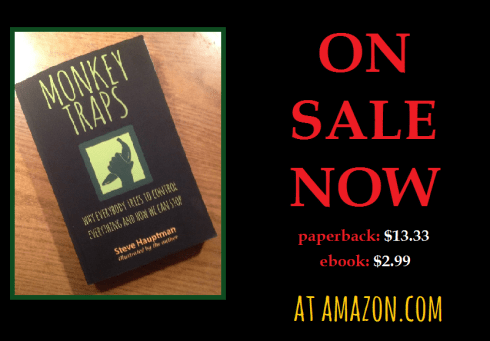
Steve Hauptman, a Gestalt-trained, Buddhist-flavored therapist with a 20-year practice on Long Island, New York, is an author and cartoonist with a great sense of humor. He is currently working on the second volume of The Monkeytraps book series. Book One, “Monkeytraps: Why Everybody Tries to Control Everything and How We Can Stop” is now available on Amazon in both paperback and e-book format.
Hauptman grew up in an alcoholic family, which pretty much guaranteed his career as a control addict. He spent is younger years struggling with anxiety and depression, then tried everything most recovering codependents do – therapy, medication, reading, self-help – all of which helped to some extent. “It wasn’t until I began studying the idea of control that I understood what was making me miserable and what to do about it.”
Hauptman has always written and always wanted to write books. He taught college writing, then began using it as personal therapy, then taught others to do the same. When he became a therapist writing seemed to be a natural way to explore what he wanted to teach about control. “I once heard about how hunters in Africa catch monkeys by tempting them to trap themselves. It seemed a perfect metaphor for human control addiction.”
People familiar with the idea of codependency will probably find it easiest to relate to Monkeytraps. Hauptman wrote it for anyone who are unhappy – anxious, depressed, addicted, struggling with relationships or parenting – and don’t understand why. The concept of control addiction offers both a new to explain all those problems and a new way to heal them.
“Bert, my inner monkey is my favorite character in my book.” Kevin shared. “He’s the part of me that tries to control stuff he can’t or shouldn’t control. We’ve been together a long time. I don’t always like him, but he did make the book possible.”
When I asked him if he has any unique talents or hobbies, Hauptman replied, “I make a pretty good hummus.”
.

.
BOOK REVIEW FEATURE ~ KEYS TO RECOVERY NEWS ~ “Monkey Traps” Book One
“Monkey Traps, Why Everyone Tries To Control Everything
and How We Can Stop” ~ Written by Steve Hauptman.
Published by Lioncrest Publishing. Review by: Beth Dewey
I loved this book before I even opened it. The Title said
it all, and it tells me that Steve has not just written about the
“problem” he is offering a “solution”.
Written on that back cover “This book is about a problem
disguised as a solution, an idea that shapes and drives us all:
Control.”
Again the problem is clearly identified.

The book begins with explaining “The Monkey Trap”,
then each chapter clearly explains the different types of Control
we think we have. Steve gives us solutions, plans, and
steps to overcome the traps we live in. I like that towards the
end of the book the chapters are titled, Acceptance, Trust,
Faith, Practicing Surrender and so. Words I relate to. Each chapter is simple and easy to read and understand, and yet so deep it could change your life from the first moment you open the book and open your heart to a solution. Easy to follow and easy to practice instructions.
I give a heartfelt “5 Stars” for this book and I will be passing it on.
Steve Hauptman is a Gestalt-trained, Buddhist-flavored therapist who has practiced
on Long Island for twenty years. A leader of Interactive Therapy groups, he is
also a cartoonist and creator of the blogs Monkeytraps: A blog about control, Monkey
House (a forum for discussing control issues).
FEATURED GUEST ARTICLE ~ Written by Author, Steve Hauptman
.

>
WANT TO TRAP A MONKEY? Try this:
1} Find a heavy bottle with a narrow neck.
2} Drop a banana into it.
3} Leave the bottle where a monkey can find it.
4} Wait.
The monkey will do the rest. He’ll come along, smell the banana, reach in to grab it. Then find he can’t pull it out because the bottleneck is too small. He can free himself easily. He just has to let go. But he really, really wants that banana. So he hangs on. He’s still hanging on when you come to collect him. And that’s how you trap a monkey.
WANT TO TRAP A HUMAN? Try this:
1} Place the human in an uncomfortable situation.
2} Wait.
The human will do the rest. He or she will try to reduce their discomfort by controlling the situation. The harder they work to reduce their discomfort, the more uncomfortable they’ll get. The harder they try to escape their discomfort, the more trapped they’ll feel. And that’s how you trap a human.
~

~
This article is about control in general, and psychological monkey-traps in particular. A psychological monkey-trap is any situation that tempts us to hold on when we should let go — to control what either can’t or shouldn’t be controlled. The world is filled with monkey-traps. As is the emotional life of every human being. I learned this from practicing psychotherapy.
Theraphy also taught me four: truths:
1. We are all addicted to control.
2. This addiction causes most (maybe all) of our emotional problems.
3. Behind this addiction lies our wish to control feelings.
4. There are better ways to manage feelings than control. I call these the Four Laws of control.
CONTROL: The ability to dictate reality. That’s how I define control. It’s not a definition you’ll find in any dictionary and probably not how you define it. But it’s essential to understanding everything that follows. Dictate means rearrange or change according to our preferences. Reality means, well, everything – everything outside us (people, places, and things) and inside us (thoughts, feelings, behavior) too.
Defined this broadly, the wish for control stands behind just about everything we do consciously. Plus most of what we do unconsciously (feel, fantasize, worry, dream) as well. We seek control in order to get reality to behave as we want it to. We seek control because we want to make the world adjust itself to us, instead of vice versa. We all want control in this sense. Not just want, either. We crave it. Control is the mother of all motivations. Every human ever born has craved it and chased it. Because it’s a craving that is literally built into us.
CONTROLLING: The urge to control is part of our hard wiring. Why?
Because it is wired into us to ~ seek pleasure and avoid pain, ~ imagine a perfect life (one that meets all our needs and makes us perfectly happy), and then ~ try to make those imaginings come true. The word controlling covers all forms of this imagining and trying. Our trying may be large (building a skyscraper) or small (killing crabgrass), complex (winning a war) or simple (salting my soup). It may be important (curing cancer) or petty (trimming toenails), public (getting elected) or private (losing weight), essential (avoiding a car crash) or incidental (matching socks). I may inflict my own trying on other people (get you to stop drinking, kiss me, wash the dishes, give me a raise) or on myself (raise my self-esteem, lose weight, hide my anger, learn French). All this involves seeking some form of control.
We’re controlling nearly all of the time. We control automatically and unconsciously, waking and sleeping, out in the world and in the privacy of our thoughts. From birth until death. The only time we’re not controlling is when we can relax, and do nothing, and trust that things will work out just fine anyway. How often can you do that?
ABOUT ADDICTS:
Addicts are people who can’t handle feelings. Usually, because they never learned to as kids. Usually, because their parents never taught them. Usually, because they couldn’t, because their parents never taught them. (Usually. There are other paths to addiction, but this is the most common.) Being unable to handle feelings is a problem since feelings tend to keep coming up. So the kid of such parents naturally starts looking around for something to make the damn things go away.
Drugs, alcohol, and food are obvious solutions. Though anything that alters your mood (work, shopping, sex, porn, TV, video games, housecleaning, alphabetizing your spice rack) can be turned into an addiction. And even when they work, these solutions are temporary. Feelings always come back. So a person without some healthier way to handle them is forced to drink, drug, eat, work, or whatever they do to make the feelings go away again. And that’s how addiction is born. Some are more destructive than others. But in the end, each addiction is the same. Because each has the same goal: To give the addict control over emotional life. And that’s why when I’m asked, “What does control have to do with addiction?” I reply, “Everything.” Because finally, every addiction is an addiction to control.
As a practical matter, every recovery from control addiction
starts with three questions:
1. What am I trying to control here?
2. Have I been able to control this before?
And if the answer to question 2 is No:
3. What can I do instead?
These are essential questions to ask ourselves when stressed because they remind us that (a) stress is what usually triggers our controlling, and (b) our controlling usually produces more stress. Not always easy to answer, though.
Because each is a trick question.
(1) What am I trying to control?
Control addicts answer this by looking outside themselves, at externals.
Please Connect with The Author Below:
Author Websites and Profiles
Steve Hauptman Website
Steve Hauptman Amazon Profile
Steve Hauptman Author Profile on Smashwords
Steve Hauptman’s Social Media Links
Goodreads Profile
Facebook Profile
Twitter Account
” Author Spotlight Presented By ~ Lyon Book & Social Media Promotions “



 "CAT'S BOOK LIBRARY 4 READERS"