
Most of us have an idea about the story of Adam.
For some, He is the First human. Others see Him as the first Prophet of this last age. If Adam was the first man ever created – when was that – 8 million years ago, or 13,000, or 3,000 years ago? In Genesis, Adam is considered the first man. Yet, He may have actually lived during the time of the great starvation.
Adam and Eve are said to have covered themselves with fig leaves in Eden, but their family is said to be fully clothed farmers living among other agricultural people. He and Eve were noted as parents (or more likely ancestors) of farmers of sporadic, domestic herds and crops, somewhere around 13,000 to 10,000 years ago. The Quran says Adam and Eve were created in heaven, and then sent to earth.
The Great Prophets or Manifestations, all concur They were created before coming to earth – as were we. But, in the Torah and the Bible, Adam is made from mud, and Eve, from one of His ribs. Each Great Prophet, or Manifestation of God’s will, was the bearer of the Holy Spirit for a new Age of human development – at times this great Holy Spirit is surprised that we haven’t reached a higher stage of maturity since the last visit.
In mortal bodies, Adam and Eve became God’s representatives and lived in a place referred to as Eden. A place where all their needs were met, until Eve gave Adam the fruit from the tree of the knowledge of good and evil. In the Qur’an, it is claimed that Adam gave Eve that forbidden fruit. Either way, they became enmeshed in the conflict between Good and Evil on earth.
With the encouragement of a snaky tempter, perhaps they made the material choice between good and evil and were evicted from Eden. Did God punish them and make them leave Eden? In the Quran, it was they who turned away from their Creator; turning towards something more worldly for a time. They later grieved the loss of connection with God. When they realized their mistake, and knew His disappointment and displeasure. They felt a great remorse, and realized that they were unable to find food.

When they were driven out from paradise, they made themselves a booth, and spent seven days mourning and lamenting in great grief. But after seven days, they began to be hungry and started to look for victual to eat, and they found it not. Then Eve said to Adam: ‘My lord, I am hungry. Go, look for (something) for us to eat. Perchance the Lord God will look back and pity us and recall us to the place in which we were before.’ And Adam arose and walked seven days over all that land, and found no victual such as they used to have in paradise.”~Genesis, King James Bible
This brings up an environmental question.
It seems that after leaving Eden, Adam and Eve suffered from a horrible famine, similar to that experienced elsewhere in the postglacial world. As the glaciers melted, the land and even the rivers dried up. The animals and fish disappeared and there was tremendous suffering. Perhaps Adam and Eve were unable to cling to the Revelation that was the very purpose for their existence. There were reasons – sanity was deteriorating.
People everywhere were starving to death, fighting over scraps, and resorting to cannibalism. This is recorded in other recollections, as in the Persian memory of those times. Mashya and Mashyana, while guarding the new Revelation of Gayomart, in Zoroastrian texts; (in Persian, Keyomars), had to eat their precious child. Quite possibly, Adam and Eve starved to death along with many of those living in the post-glacial drying regions.
So, did the serpent represent human frailty or a need for a material attachment to the earth for existence? In those desperate times, the Ancient Faith was again corrupted. People made sacrifices to the rain god or a fertility goddess. Maybe Adam’s followers chose idol worship; praying to elements as gods, or calling on personifications, icons, or statues, for specific personal favors like finding food, water, or freedom from having to eat, or be eaten by those around them.

Leaving Eden means so little as a sentence, but understanding the real-life environmental drama gives significance to those words. Our ancestors could no longer satisfy their needs from the forests and the waters. Many died from outright hunger, thirst, or cannibalism. Adam and Eve were likely unable to hold onto the holy Revelation. Some humans endured, but perhaps Adam and Eve did not.
This is our human history – and may God forgive us – maybe our future too. Again, we’re faced with global warming, starvation, and death as rivers shrink and storms rage. However, in God’s mercy, starvation became the engine that impelled humanity to tame plants in their desperate hopes for survival. Over time, Adam and Eve’s descendants became ancestors to early farmers like Cain and Able who learned to raise and defend patches of herbs, vegetables, grains, and fruit. They even confined a few treasured animals in small breeding flocks; all the while trying to defend their tiny farms from fierce raiders and starving neighbors.
The concept of sacred white bulls, and not eating sacred cows, is an ancient remnant of those times. With the guidance of several succeeding Great Prophets, this process eventually led to the grouping of farmers into communities, or early cities defended by warriors, and ruled by law. Civilization had started its path. Eventually, there was enough food to initiate barter, then trade; forming routes for the transfer of goods and ideologies. Does this layering of the exploits of an early Prophet’s life sound familiar?
In the stories of the first remembered Great Prophets, the shreds of memory cover thousands of years, yet only one name serves as the “First”, though many Prophets whose names were forgotten over time, came in between their age and the age of the next remembered Prophet. Besides Adam, other first-remembered Prophets you’ll want to check out are: Nu Wa, Gayomart, Rama, and Fu-Xi. Adam’s Revelation was followed in sequence by Seth, on the flickering cusp of domestication.
Seth’s descendants built two pillars inscribed with many scientific discoveries and inventions – notably in astronomy in order to protect the knowledge so it could be remembered after the destructions of flood and fire, which Adam had predicted. One was composed of brick, and the other of stone, so that if the pillar of brick should be destroyed, the pillar of stone would remain. Enoch, known by many names like Hermes, Thoth, and Idris worldwide, gifted us His massive Revelation before the flood. His philosophies, sciences, and libraries still influence our societies today.

In the End
Our first remembered Prophet’s painted for us a tremendously long prehistory.
They brought richness and noble beauty to the development of human religion, society, and culture. They took on the forces of evil rulers, idolatry, and ignorance to renew the Ancient Faith. They had one goal – for humans to worship the Supreme Creator: to purify their hearts and to turn away from self and materialistic distractions; to refrain from forming cults and making offerings to various elements, talismans, idols, or icons in order to get something in return.
The Ones we can name guided us through three global stages. First, the hunter-gatherers who lived in lush lands in times of relative plenty. Next, a cold, drying climate caused starvation and cannibalism. Finally, they drew a path for the success of domestication, agriculture, and trade; then guided us through the glimmerings of civilization, helping us achieve a civil, just, and compassionate organization of society. Each, renewed the ancient Faith of God, which was tarnished time and again, by human perceptions and changes to the holy Word.
And that renewal continues today.
**********
While sharing this shard/excerpt of her first published book, “Ancient Ways: The Roots of Religion,” Diane hopes you will purchase and read the full book. In the book, Diane explores how we can trace our connection from the beginning of Earth’s creation to our present times, and delves into various topics that highlight our unity as one humanity.
Here is more information about the book…
It is available from Amazon.
https://www.amazon.com/dp/0996756558/
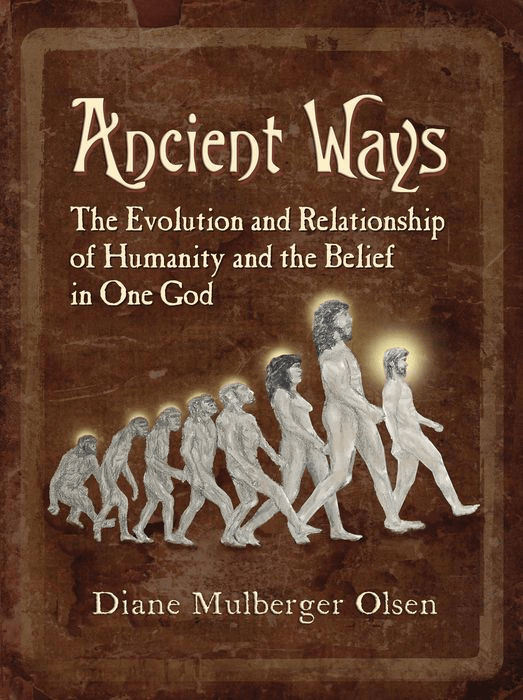
ABOUT THE BOOK:
To enjoy this book you may have to suspend current beliefs, since some of the concepts may seem quite foreign at first. What if monotheism always existed, and revelations were given to all human forms. There are hints to that effect. We should not assume primitive peoples weren’t smart enough to grasp the concept of a single Creator!
Too often we tweak religion to reflect our personal thoughts rather than dealing directly with the Word of God. Monotheism, today is represented by at least nine living faiths, yet praying to God alone is not enough, for many. Instead, we pray to Prophets, angels, saints, ancestors, deities, and even the universe. This creates a chain of “Paths” and “Ways” that become stained, over time, by human desires for control and material benefits. And as darkness and materialism overtake one Faith, another is born, through the intervention of the Holy Spirit, which is clothed in a different form, with a new name, and very familiar teachings.
Like the Tree of Life, monotheism can be visualized as a chain linking prehistory and history, entwined with human additions, wisps, and twists that produce an undulating, ultimate Yin and Yang. This constant interaction of complementary, as well as conflicting, forces and energies, exhibits both organic unity and dynamism-even war. Those who suspect there is a unified core of basic beliefs will enjoy Ancient Ways.
Hopefully, you will find precious gems to take with you.
 "CAT'S BOOK LIBRARY 4 READERS"