Cat’s PR Friends Show us How To Social Media For ‘Building Your Brand and Use It To Grow Your Small Business Too.

Cat’s amazing friends of Strong Social – Media Blog is a great place to visit as they are a growing PR media site that helps “the little guys” become better at branding themselves as authors, writers, and if you are like me, run a small media marketing and book promoting brand and business.

They know the importance and power of Social Media to help authors build their brand and gain exposure, sales, and reviews for all their books. Let’s see what they are teaching us today about Branding and Using Social Media for your small business …~Cat Lyon

……..

Facebook, Flat, Flat Icon, Social, Icon

…….

4 Easy Tips to Apply Social Media Strategies to get your Brand Noticed

Social Media is no longer something that companies can go without. We’ve long past that time when small business owners thought that communicating with their key audience was more of a choice, rather than a mandatory necessity.

It so happens that being present on social networks has become a must in almost every sector of activity, and here are the top 5 social media must-haves for every brand:

5. A Social Media Manager

Sure, it sounds redundant, but trust us. Having a social media manager is mandatory if you want to get optimal results from your entire digital communication strategy. You can start by creating the social media accounts for your brand by yourself and try to keep them constantly updated, but sooner or later, you’ll realize that this activity is taking up more and more of your time.

This could lead to you getting distracted from your company’s core focus, making it necessary to hire a professional social media manager to take care of the work and to take things to the next level.

4. Instagram and Youtube Are a Must-Have

Even if you’re not activating in a very dynamic domain, your brand needs to be present on Instagram and Youtube. Assuming you already have a Facebook and a Twitter account, you should start placing a strong focus on the visual like book trailers or more about your craft as a writer.

When it comes to visual, Instagram (for photos) and Youtube (for videos, of course!) are the key social networks to focus on. More and more companies are shifting their communication efforts to visual content, because, we all know it, people have less and less time to read.

Keep it social with strong visual content!

3. Focus on Understanding Social Media Management Tools

If your brand has a lot of things to communicate, you can easily forget to post certain updates or news because you are present on too many platforms. This is why opting for a social media management tool that helps you organize and schedule posts on different social networks is a life-saver.

Hootsuite is one of the most popular choices out there, but feel free to look around to what best suits your needs, or consults with your social media manager (if you already have one) on what tools you should start using.

2. Try Getting More into The Analytics

Sprout Social is a very special social media solution for every brand. It’s being used by top worldwide companies because not only does it make social media easier to manage, but it also provides detailed-customized reports to help you improve your digital communication. And save time posting by automating your posts on social media by using Buffer (dot) Com. They are an affordable Social Media Management Platform.

“Buffer makes it easy for businesses and marketing teams to schedule posts, analyze performance, and manage all their accounts in one place.”

They both can also be considered strong lead generators for your business if you analyze all the reports carefully and make the necessary adjustments in order to achieve your business goals.

It’s definitely worth giving it a shot!

1. Focus on hashtags

Hashtags are as important today as they were the first time they were introduced by Twitter. It helps people search and index a certain topic, making it easier for you to connect with your core audience.

Use websites like hashtagify.me to get the best relevant hashtags you need to send out your message. Hashtags are one of the easiest ways to make your message visible to a wider audience, so be sure to include them in your updates.

Now let’s talk about to grow your business on Social Media!

……..
Social Media, Facebook, Twitter

…….
5 Tips on How to Use Social Media for Small Businesses

…….

It’s no longer a secret that social media helps any business in reaching its targeted audiences. Not only that, but social media has become a must-have for any business, be it big or small. It’s a very fast, efficient and easy to use way of getting in touch with your current and future possible clients.

It helps in raising awareness about your company, it helps in getting leads for your business, and it’s a way of letting people know what your company is doing on a regular basis.

Sure, everything sounds good in theory, but let’s look over 5 tips on how to use social media for small businesses. A more practical approach.

5. Start by setting up a social media plan for your business

First thing’s first. Set up a social media plan where you do an audit of your company and try to figure out which social networks work best for your industry. We’re not going to lie to you, research does take up a lot of time in the beginning. Help is out there, and affordable if you “just want to WRITE,” look to our friend ‘Cat’ of lyonmediaservices.com and she can surely help. WHICH?

…….
imageedit_7_9080497309

The good news? That it’s worth it and you only have to do it once. At least to that extent. After that, it’s all about her trying to keep you relevant in your field and do constant check-ups on what the competition is doing. Which brings us to our next tip…

4. Research your competition and keep up to date with the latest news

In the digital age, not knowing what your competition is doing is a definite disadvantage. Especially since doing research or checking updates from your competitors has never been easier.

Start by following their social media accounts and see what they’re posting. Analyze their content and try to identify a pattern. See what works with their audience and how they engage with people who approach them. You can even take it a step further, by subscribing to their newsletters, webinars, conferences and so on, just to be sure that you’re always in the loop.

Take whatever works from their social media communication and add it to your plan.


3. Master one social media platform

Spreading too much, too fast is almost never a good idea. Sure, start by creating social media accounts for your business on all the relevant social networks, but try to master one platform before being “too social” on all of them.

Time is a limited resource and most likely, you will not be able to invest the same amount of time on all social networks. Rather than having 3-4 accounts with less developed content, try on focusing on one and get yourself noticed there. After that, it’s easy to scale and take a part of your audience with you. This blends with the next tip we have in store for you.

2. Engage with your audience. See what they have to say

This tip is probably the most important one of them all, however, this does not mean that you should skip all the other steps. Engaging with your audience can prove to be crucial, especially when you are a small business or a company that’s just starting out.

Your customers and the relationship you build with them is all you have. This is why you need to nurture it and put almost as much time in it as you would put in your products and services. Establishing a loyal fan base is key in taking your business to the next level. Answer questions and ask questions. This will get the ball rolling.

1.Create Your Brand Recognition

If you manage to create a strong brand recognition, you can already consider yourself a winner. Of course, this doesn’t mean that you should leave your guard down, but it does mean that you will need to put less effort into your communication activities and you can focus on taking your business even further.

You’ll be able to focus more on developing your product, think about scaling up and how to acquire more customers, once your company has established itself as a strong brand.

You’ll be able to communicate more, by saying less. You’ll appear professional, but also close to your audience.

#############

If you’re interested in learning more about social media management, or if you have any questions about social media for small businesses, do not hesitate to contact our specialized consultants. CAT SURE Highly Recommends Them!!

……..

No photo description available.


“Ode to The Book Review”… Readers? How Come You Won’t Leave a Review When Done Reading a Book?

Welcome Avid Readers. Authors, and All-New visitors, 

As a book marketer and promoting many fine authors, the biggest thing that eludes ALL AUTHORS, WRITERS, and Marketers … WHY DON’T A READER LEAVE A BOOK REVIEW? 

Seriously. I really want to know what the reason is. If you are an AVID Reader, then you know how important a book review is for a writer who hards very hard on their craft and then to have the audacity to publish their work …

AND IS WHY a book review for us is so important. Be it a good, bad, or indifferent, book reviews are a way readers can let writers know how and why they loved a read or …not so much. It offers us, as writers, maybe some corrective advice if say a good mystery was missing elements or maybe the ending could have been better.

So, I came across a few book blogs that had some good advice and shared feelings of WHY books reviews are so important and thought I’d share them. As readers, I hope it will help all my readers who visit to understand the “WHY”…  *CAT*

<<<<<<<
3367

<<<<<<,

Hello, readers!

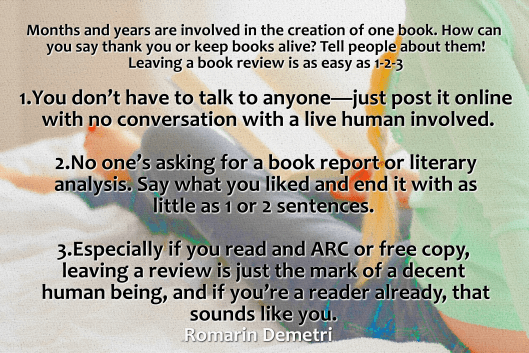
Remember, you don’t have to purchase my books from Amazon to leave a rating or review. If you were gifted any one book, downloaded them for free, bought them, found them in a Little Library, found them at a rest area, at a mall, some other random place, etc… You can still leave a rating. I encourage and ask that you do so, regardless of how you received any copies. If you really enjoyed my books, let me know. My main concern is how well you liked my stories, not how much I can make.


Ratings and reviews really help. It helps other readers know that they are getting a good read, and it also helps me, the Author. When I see how much someone enjoyed one of my books, it reminds me why I’m doing this in the first place. I want you to have a new literary universe that you can lose yourself in after you had a long, frustrating, or busy day.

So, go ahead and leave a rating or review at AmazonGoodreadsBarnes & NobleBooks A Million, etc. You don’t have to post much more than two or three words if you don’t want to. Even just a star rating will do. After that, you can follow me on my many social media platforms.

Thanks, and I as all authors appreciate the time you spent reading our books and reading this post! 

<<<<<<<
3review1


A SAMPLE OF HOW TO WRITE A QUICK BOOK REVIEW:

Since most reviews are brief, many writers begin with a catchy quip or anecdote that succinctly delivers their argument. But you can introduce your review differently depending on the argument and audience. The Writing Center’s handout on introductions can help you find an approach that works.

In general, you should include:

  • The name of the author and the book title and the main theme.
  • Relevant details about who the author is and where he/she stands in the genre or field of inquiry. You could also link the title to the subject to show how the title explains the subject matter.
  • The context of the book and/or your review. Placing your review in a framework that makes sense to your audience alerts readers to your “take” on the book. Perhaps you want to situate a book about the Cuban revolution in the context of Cold War rivalries between the United States and the Soviet Union. Another reviewer might want to consider the book in the framework of Latin American social movements. Your choice of context informs your argument.
  • The thesis of the book. If you are reviewing fiction, this may be difficult since novels, plays, and short stories rarely have explicit arguments. But identifying the book’s particular novelty, angle, or originality allows you to show what specific contribution the piece is trying to make.
  • Your thesis about the book.


Summary of content:

This should be brief, as analysis takes priority. In the course of making your assessment, you’ll hopefully be backing up your assertions with concrete evidence from the book so some summary will be dispersed throughout other parts of the review.

The necessary amount of summary also depends on your audience. Graduate students, beware! If you are writing book reviews for colleagues—to prepare for comprehensive exams, for example—you may want to devote more attention to summarizing the book’s contents. If, on the other hand, your audience has already read the book—such as a class assignment on the same work—you may have more liberty to explore more subtle points and to emphasize your own argument. See our handout on summary for more tips.

Analysis and evaluation of the book:

Your analysis and evaluation should be organized into paragraphs that deal with single aspects of your argument. This arrangement can be challenging when your purpose is to consider the book as a whole, but it can help you differentiate elements of your criticism and pair assertions with evidence more clearly. You do not necessarily need to work chronologically through the book as you discuss it.

Given the argument you want to make, you can organize your paragraphs more usefully by themes, methods, or other elements of the book. If you find it useful to include comparisons to other books, keep them brief so that the book under review remains in the spotlight. Avoid excessive quotation and give a specific page reference in parentheses when you do a quote. Remember that you can state many of the author’s points in your own words.

Conclusion:

Sum up or restate your thesis or make the final judgment regarding the book. You should not introduce new evidence for your argument in the conclusion. You can, however, introduce new ideas that go beyond the book if they extend the logic of your own thesis.

This paragraph needs to balance the book’s strengths and weaknesses in order to unify your evaluation. Did the body of your review have three negative paragraphs and one favorable one? What do they all add up to? The Writing Center’s handout on conclusions can help you make a final assessment.

IN THE REVIEW:

Finally, a few general considerations:

  • Review the book in front of you, not the book you wish the author had written. You can and should point out shortcomings or failures, but don’t criticize the book for not being something it was never intended to be.
  • With any luck, the author of the book worked hard to find the right words to express her ideas. You should attempt to do the same. Precise language allows you to control the tone of your review.
  • Never hesitate to challenge an assumption, approach, or argument. Be sure, however, to cite specific examples to back up your assertions carefully.
  • Try to present a balanced argument about the value of the book for its audience. You’re entitled—and sometimes obligated—to voice strong agreement or disagreement.

    But keep in mind that a bad book takes as long to write as a good one, and every author deserves fair treatment. Harsh judgments are difficult to prove and can give readers the sense that you were unfair in your assessment.

  • A great place to learn about book reviews is to look at examples. The New York Times Sunday Book Review and The New York Review of Books can show you how professional writers review books.

    #########

>>>>>>>

IT REALLY IS SIMPLE!

<<<<<<<

imageedit_7_9080497309

Authors? How Do You Build a Brand and Media Presence and Look Good Online? Read This Guest Article and Learn How!

How to Build a Brand Presence and Look Better Online.

BY: My Friends of Strong Social …

Building a better brand presence and looking better online overall is no easy task. In fact, is one of the first challenges everyone encounters when they start a new business. Sure, you create accounts on all the relevant social networks you can think of, but how do you take the next step?

How do you build a strong brand presence on social media and how can you make it look even better? With all the competition out there and all that “social media noise”, it’s not going to be an easy process, but here are a few tips that will help you achieve your goals.

1. Make sure you have a great website.

You can’t build a better social media brand presence without a plan in mind, and you can’t build an effective plan without taking into account the importance of having a great website. Sure, “great” may seem like a pretty vague and generic term, but there are actually quite a few must-have factors that make a website to be indeed great.

Make sure that your website has been designed based on all the latest trends, without neglecting UX & UI, and try to make it as SEO friendly as possible with the content that will be posted there. Remember, your website is the window to your business so don’t forget to keep it clean and to the point.

After implementing this initial step, you will be able to establish your brand voice and better communicate with your audience on your own platform (your website) and on social media, thus making you look better by being more connected with your current clients and future possible customers.

2. Make sure that you are on the big 3 social networks – Twitter, Facebook, Instagram.

If you want to reach a larger audience, it is imperative to build a social media presence. It helps you reach out to people that don’t know you, your business and your website. It’s also the best way to send out updates to your entire target audience.

Twitter, Facebook, and Instagram are definite must-haves for any business that wants to survive in the digital age. This is already well too established as a general condition for getting your products and services known around the world with fractions of the costs of traditional advertisement. These three social networks will raise awareness about your brand and it will make people engage with your company faster and much more efficient.

However, using social media tools does not imply that you should not be present on your accounts as much as possible to engage with your audience in real time. Answering fast and honest is always better than answering late and impersonal through a generic website reply.

3. Create lots of blog content and use it effectively.

Write, write and then write some more. If you have reached this stage, this means that you already have a functional website online and you are present on all the important social networks: Twitter, Facebook, and Instagram. So, what do you do next?

Simple. You start by sharing your content throughout your social media, thus making your brand known throughout your audience. Share content that is relevant to each target group in part and you will quickly see the engagement rate with your brand increasing. Just don’t forget to write good blog content which appeals to people interested in your area of expertise, in your industry and, last but not least, in your products, services, and your brand. A good series of blog content goes a long way.

>>>>>

Behind-the-Books

<<<<<<<

4. Engage with your followers with exceptional content

This step is probably the most important one if you want to build a strong brand presence and look better online. People want to be noticed and they want to relate to the brand they interact with.

A great website with good blog content and a strong social media following could become worthless if the brand does not interact with its fans and followers. People want to be noticed and they want to be heard. If they comment, engage with them. Answer their questions. Ask questions yourself. See what their needs are and try to get as much productive feedback as possible.

Listen to your audience and adapt your brand to answer as many of their needs as possible. Engage, engage and then engage some more!

Be sure to take into account all these tips if you want to build a stronger, more effective, and not to mention prettier brand on social media. If you’re interested in learning more, check out our website at Strong Social …

########

<<<<<<
imageedit_4_5758312847

News & Experts Are Back and Marsha Shares WHY a Media Pitch Needs To Be Well Planned To Be Successful …

4 Tips For Creating Successful
Media Pitches
 by | Feb 19, 2019

….

Anyone who’s tried their hand at promoting a brand through PR can tell you that grabbing the media’s attention isn’t always easy.

Each day, newspaper journalists, as well as hosts and producers of TV and radio talk shows, scroll through a never-ending barrage of email messages, many of which they no doubt delete without reading.

Let’s face it, they couldn’t write about or report on all those topics even if they wanted to. Time just doesn’t allow it. So, with competition for the media’s attention so fierce, is it even possible to separate yourself from the pack and land an interview that will help build your credibility as a go-to expert in your field?

I’m here to tell you that, yes, it is possible, though a challenge if you have no experience playing the media’s game, which is why so many people turn to professionals. Still, if you’re determined to do it on your own, let me share a few things you need to keep in mind that can help you achieve success.

First, remember that while your goal is to promote your personal or company brands, that’s not the media’s goal. If your pitch sounds like a commercial, the media will suggest you contact their advertising departments.

As I point out in my upcoming bookGaining the Publicity Edge: An Entrepreneur’s Guide to Growing Your Brand Through National Media Coverage, what the media actually do want is useful and interesting information they can share with their readers, viewers, and listeners.

So, with that in mind, here are four tips to help make your pitches more successful:

  • Keep it short. You no doubt have a lot to say about your topic, but don’t say it all in your pitch. Print journalists and TV and radio show hosts don’t have time to read a thesis, no matter how remarkable your insights are, so keep it succinct. Think of those pitches as more like a movie preview, not the feature presentation. Certainly, include enough information for them to get the gist of what you can talk about, but leave all those extraordinary details you are tempted to cram into the pitch for the actual interview.
    ….
  • Solve a problem. The best ideas for articles and talk show interviews are those that help solve a problem the readers or audiences face. People perk up when your message means something to them personally, such as providing them tips on how to stick with a diet or save more for retirement. Ask yourself this: What are some of the problems my clients or customers are trying to solve? Those problems—and the solutions you can offer—can be the inspiration for a pitch.
    …..
  • Playoff what’s happening in the news. You increase your chances of engaging the media’s interest if your pitch aligns with something they are already writing and talking about. What’s going on that fits into your area of expertise? Are you a surgeon who can explain a new breakthrough involving your specialty, and what it will mean to patients? Are you a divorce lawyer who can comment on the latest celebrity split? One of our clients was a scientist who could talk about an eclipse that was in the news. We kept him busy with radio interviews leading up to that astronomical event!
    ……
  • Highlight your credentials. Why should the media—and the media’s audience—listen to you? Don’t dump your entire resume in the media’s laps, but you do want to include a short summary of relevant information about your background and expertise. For example, if you are a financial professional, let them know what licenses and certifications you have, and that you’ve been a partner in your firm for 10 years.

Finally, understand that pitching the media can take patience. Your first pitch might not get any takers. Your second and third might not either.

Don’t despair. At the end of your pitches, let the media know that if they have no interest in this particular idea, you’re available to talk about other topics related to your expertise as well.

“In the publicity game, persistence pays off.”

Diligently yours!

Marsha Friedman,  PR Expert

>>>>>


Marsha From PR Insider Is Back Sharing Why Publicity Is Important If You Are Online Like Cat …A Lot!

How smart ‘influencers’ are benefiting from publicity!

Why Publicity is the Next Step for Online Influencers

….

Marsha Friedman

Practically all of us are on social media these days, but some of us have found ways to make a bigger splash than others.

These are the people who have become known as social media influencers. They have established credibility in a specific industry, drawn a ton of followers, and each day manage to use that credibility and reach to persuade others.

A couple of the more extreme examples are Zoe Sugg, a fashion and beauty blogger with nearly 40 million online fans; and Mark Fischbach, a video-gaming guru with more than 20 million subscribers on YouTube as well as millions of followers on other social media platforms.

Other social media influencers may not have nearly as much reach, but all of them have established themselves as trusted sources of information for their followers – and, yes, can influence those followers when it comes to making decisions.

But here’s what I believe: Even an online influencer can benefit from a publicity effort that targets the more traditional media, such as print, radio, and TV.

In fact, I’ve seen that play out just recently with one of our clients, who has a YouTube channel with more than 13 million total views, and a large following of more than 1.5 million fans – and counting – across his social media pages.

Yet, despite that success, he also recognized that some old-fashioned publicity could spotlight him before an audience he hadn’t previously been reaching. He came to us to arrange interviews with the press, and TV and radio shows–connecting his digital presence with the traditional media.

And let’s face it. If even influencers need the credibility that publicity in traditional media gives them, then certainly you do, too.

So, here are a few reasons influencers – and you – should make use of print and broadcast media to gain publicity:

  • Diversify your audience. Yes, if you’re an influencer on Instagram, for instance, you have high-name recognition among your followers – and that’s wonderful. But how does that name recognition hold up when you stray away from those followers? If you want to establish yourself as a widely recognized authority in your field, it’s important to diversify your audience. A proven way to reach that broader audience is through interviews with the print media, with TV  appearances and with radio talk-show interviews.

    …..
    Image result for free images of social media
    …..

  • Elevate your sphere of influence. Those media and social media interviews do more than just get your name floating around. They also add to your credibility. Whenever you appear in print, on TV or on talk radio, you are in essence receiving an implicit endorsement from the media, which decided you had something worthwhile to say to their audiences. You stand out from your competitors, and now have an edge over them. In short, elevating your sphere of influence also elevates you.
  • Grow your audience even more. As you get that publicity in the mainstream media, many more people will learn about you and some of them are likely to become followers on your social media platforms. Your success builds on itself.
  • Grow your business. If you are a social media influencer who derives income from advertising sponsors, then you can leverage your influencer publicity to attract even more sponsors. In addition, all the new eyes that find you, as a result, are potential customers or clients for your product or service.

    ….

In all these ways, publicity for influencers is like publicity for anyone who wants to raise the profile for a business or personal brand. As you build your credibility through your success with the media, you can set yourself apart and gain an edge over your competitors.

Influentially yours,

Marsha

….

All About The HOW’S To Use Book Bub Partner Book Ads. Authors, Are You Listed Yet on Book Bub? Great Place For Readers Too!

Now we know how difficult it is to promote and market our books to the right “niche” of genres and target who our book readership is. I know, as I do it for a job! Lol. One way is to place yourself on as many book sites that have and target readers of all genres as possible. Next, keep a couple book ads running on some different book sites like here on Book Bub For Authors.

Authors can set themselves a nice author profile with photo, bio, and more. Then you can list your books. Now there are two ways you can advertise your books to Book Bub’s large readership. You can apply and submit your book for a “Featured Deal,” but sadly, they only chose 20% out of 100% of new books submitted. But, below, is an article that walks you through the HOW’s on how to use their other book advertising through their Book Bub Partner Ad network from your author dashboard. Now many are not as computer savvy or know how to do or set “Budget Ads.”

So I found this Exceptional Article on Book Bub’s Blog written by Carlyn Robertson who works in product marketing on BookBub’s Partners Team, where she ensures all authors & publishers know how to use all BookBub’s tools to achieve their marketing goals. She writes content for the partners’ blog & website, speaks at conferences, & conducts market research. So make sure you follow her on Twitter at @CarlynAtBookBub.

Here is what she shares about how to effectively use Boob Bub Partner Book Ads!

<<<<<
Carlyn Robertson

How an Author Doubled First-in-Series Sales Using BookBub Ads

<<<<<
How an Author Doubled First-in-Series Sales Using BookBub Ads

Many partners use BookBub Ads to continuously promote first-in-series books. Because you can run ads on an ongoing basis, you can introduce a consistent stream of new readers to book #1 and drive sales for the whole series.

Eva Pohler doubled daily sales for her $3.99 first-in-series supernatural suspense by running a continuous BookBub Ads campaign. She increased sales across different retailers and regions, and over the past month, her campaign has been ROI positive. Here’s how she did it!

Campaign Goals

Eva’s primary goal for this ad campaign was to drive sales of book #1 in her Mystery House series in the lead-up to the launch of book #3.

Series Image


My goal for this campaign was increased sales. I began the campaign for Secrets of the Greek Revival a month before the release of the third book in the series, French Quarter Clues, with the hope of prepping new readers for the third book. I immediately saw an increase in sales of book #1 and #2, and I believe my release was positively affected by both the ad campaign for book #1 and a Featured New Release for French Quarter Clues.

Campaign Execution

Creative

Eva designed her ad image using tips she’d seen on our Partners Blog.


BookBub Ad Creative

My mistake in past graphics was trying to fit a one-line synopsis, which cluttered the visual. I learned from a Partners Blog post that I could help readers know what the book was about with images rather than cluttered text. I also used to make the book cover the most prominent part of the ad — taking up at least half of the graphic. After viewing images in the blog post, I learned that the book cover could be made smaller so that a line of text could fit along the top or bottom of the ad, making the ad look more cohesive.

Targeting

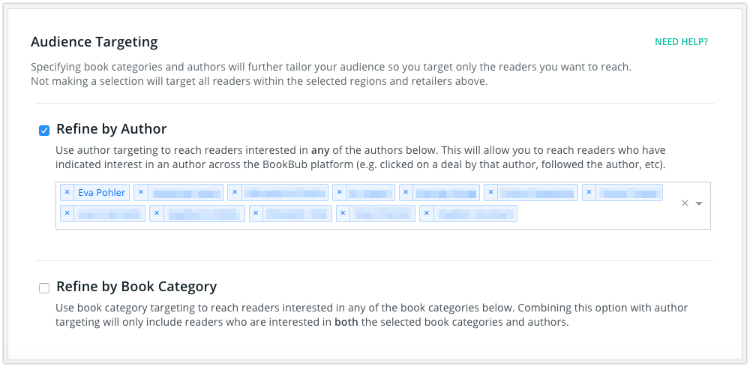
Eva ran a number of tests before settling on an ad that targeted her own fans on BookBub plus the fans of 20 similar authors. She included links to Amazon, Barnes & Noble, Apple Books, Kobo, and Google Play in all worldwide regions where each retailer is available.

I tried targeting just genres, just authors, and both genres and authors. I found the ads that targeted only authors performed the best. I’ve also found that my ads don’t always start off with a bang. They take time to perform well. I think this may be because the ad needs to be seen once or twice before a person will finally click on it.

BookBub makes it easier than Facebook to target specific authors, because many of the authors I use are not available as targets on Facebook. I chose the authors by looking at the top sellers (on Amazon) in the genre of whatever book I’m marketing.

BookBub Ads - Author Targeting

Budget and Bid

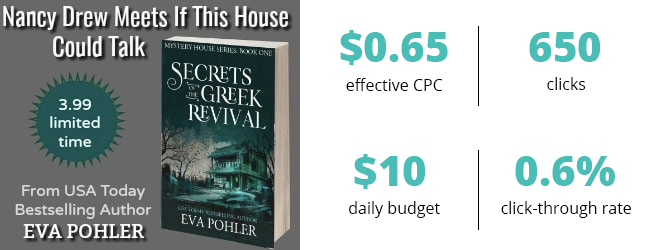
Eva set up a continuous campaign with a daily budget of $10. She chose CPC bidding and set her bid above the average range we display to ensure that her ad would be competitive in the auction.

When deciding on a budget, I consider things like the length of the series, the sell-through rate, the price of the first book, the effect on rank, my overall marketing budget, and my return on investment. The third book in the series just released, and as the length of the series increases, I hope to increase the ad spend depending on the sell-through of the later books.

I chose to pay per click rather than per thousand impressions because the former gives me valuable feedback about which readers are responding to my ad. For example, most of the people clicking on Secrets of the Greek Revival are Barnes and Noble readers or readers from Canada (at both Amazon and Kobo), whereas most of the people clicking on my ad for another book, a YA paranormal, are US Kobo readers.

I chose a $2 CPC bid because I want to win the best bids, and I rarely end up actually spending that much per click. My average cost per click is more like $0.66. While that may seem high to authors used to paying less per click on Facebook ads, BookBub leads are much ‘warmer’ because your targets are already wanting to find books. I think it’s reasonable to have to pay more per click for warmer leads. And, ultimately, the ROI is what matters more than anything. I make more on the ad per day than I spend. As long as that continues, I will keep running the ad.

Campaign Results

BookBub Ads Results
<<<<
When analyzing her results, Eva was primarily focused on comparing the cost of the ad to the sales she could credit to it. Since she wants to drive sales for the whole series, she has links to purchase book #2 in the back matter of book #1 and calculates her ad’s profitability based on the total series sales (not just book #1 sales!). Eva estimated her series sell-through by dividing book #2 sales by book #1 sales within a given time frame and multiplying by 100 — 22% of the readers who purchase book #1 in the Mystery House series go on to buy book #2.

BookBub Ads increased the sales of Secrets of The Greek Revival from two or three a day to five or six a day (sometimes more). Although the CTR is important, I’m mostly concerned with this: how much am I spending per day versus how much am I making per day (on sales that can be attributed to a given ad).

I’m able to measure the effects of my BookBub Ads on my sales because they are the only marketing I do for readers who use retailers other than Amazon. I’m investing more time and money in BookBub Ads because I feel that the people seeing these ads are looking for books, which isn’t always true with Amazon and Facebook. I use Amazon ads and Facebook ads to target Kindle users, but I’ve found BookBub Ads to be better than Facebook at targeting Nook, iBooks, Kobo, and Google Play readers. I can also see an increase in Kindle sales with my BookBub Ads, but it’s just more difficult to measure.

Tip: Use our bidding calculator to determine your own series sell-through and calculate how much you can afford to spend on ads for the first book in your series!

I’m investing more time and money in BookBub Ads because I feel that the people seeing these ads are looking for books, which isn’t always true with Amazon and Facebook.” @EvaPohler #pubtip CLICK TO TWEET

Takeaways

Eva has also run ads for her first-in-series books in other genres and has gleaned some interesting insights about the impact of genre, price, and platform on her ad performance by comparing the results of her campaigns:

B&N sales have increased the most with this ad for Secrets of The Greek Revival. When I compare the results to an ad I have for a YA paranormal novel called Vampire Addiction, also priced at $3.99, I find that Kobo readers are responding really well to that one. The CTR at Kobo for that book has been close to 5%.

The Gatekeeper’s Sons, the first in my longest YA series based on Greek mythology, has given me the most grief. I’ve been experimenting with pricing after it was permafree for five years. Because Secrets of the Greek Revival did so well at $3.99 with BookBub Ads, I tried to do the same with The Gatekeeper’s Sons. However, it did not sell well at $3.99. I recently changed it back to free, and now that ad is doing really well, especially at Kobo. Even though The Gatekeeper’s Sons is free, I spend $15 per day for that book on BookBub Ads because it’s part of a long series, and I make money on the sell-through to the other books, which is at a rate of 33%.

Want to boost sales for your own series? Create a new ad for book one now!

Want to share this post? Here are some ready-made tweets:
<<<<

Click to tweet: See how one author DOUBLED her first-in-series book sales! #writetip #pubtip http://bit.ly/2TjI4Bl

Click to tweet: Fascinating case study for how an author doubled sales for the first book in her series! #publishing #amwriting http://bit.ly/2TjI4Bl

<<<<

FREE: The Ultimate Guide to Promoting a Book Launch


Subscribe to the BookBub Partners Blog to get your free flipbook right away. You’ll also get BookBub’s latest book marketing tips and insights delivered to your inbox each week.

Stop By the article page here “Guide to Promoting a Book Ad and Launch.”  Just scroll down to the end of the article and download your FREE COPY TODAY and get selling MORE BOOKS!!

CAT